Meeting the instrument and first tuning
Everything you need to know about the instrument in front of you, in ten minutes: the parts, the strings, how to sit without aching, and how to tune it so that it stays in tune.
First things first: well done on picking it up. Holding a guitar for the first time is a bit like being handed a spaceship — a lot of parts, a lot of strings, and no idea what does what. The good news is that everything you actually need in order to start fits into a single lesson.
By the end of this page you will be able to call every part by its name, count strings without getting lost, sit down without your shoulder complaining after five minutes, and tune your instrument so that it sounds like a guitar rather than a squeaky door.
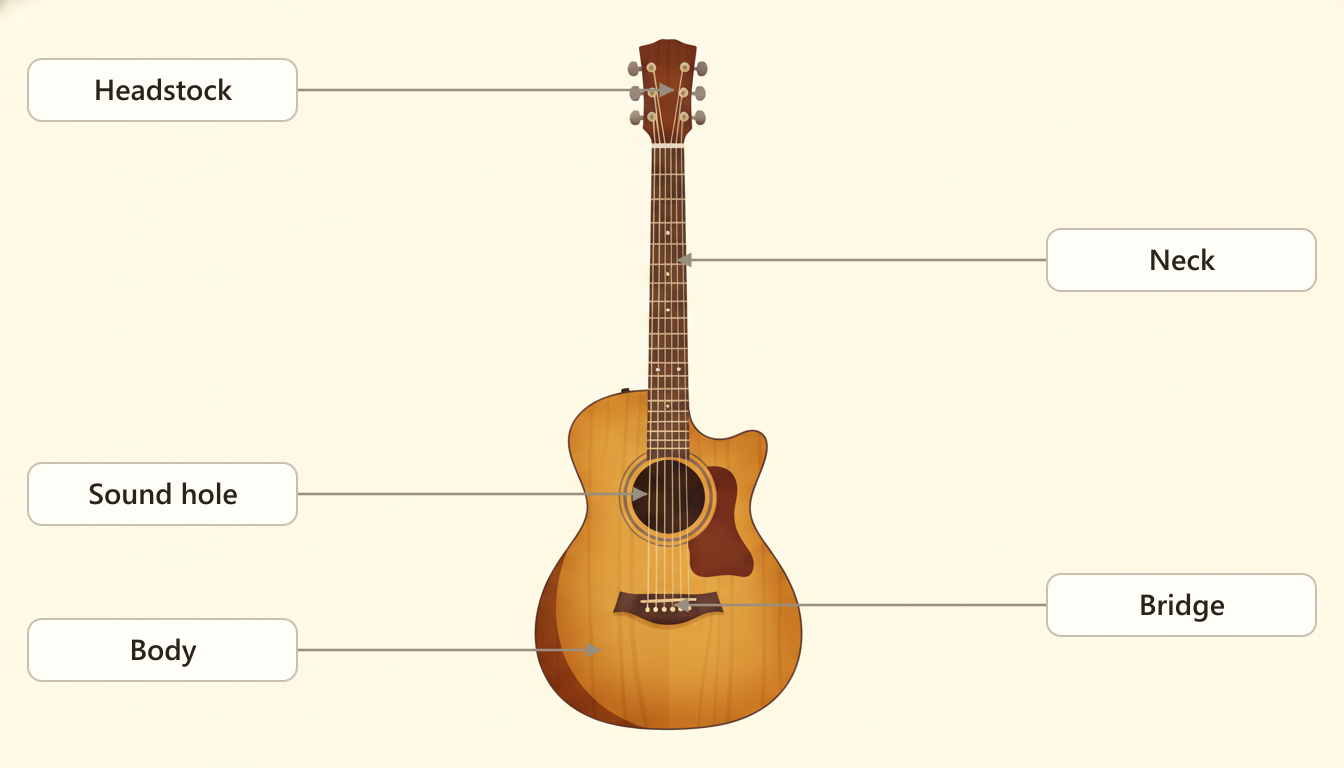
A guitar has dozens of named parts, but three of them do most of the work.
The body is the wide, fat part. On an acoustic guitar it is a resonating box: the string vibrates, the vibration travels through the bridge into the top piece of wood, and the box amplifies it into the sound you hear. That is why a cheap guitar and an expensive one sound so different — almost everything is decided in there. On an electric guitar the body is solid, and the job of amplifying moves to the magnetic pickups sitting under the strings.
The neck is the long strip your hand climbs. The fretboard is glued onto it, and the metal bars crossing it are called frets. When you press a string down you are really shortening it — from that moment it vibrates only from the fret wire to the bridge, and the shorter it is, the higher the note. That is the whole secret. No magic, just length.
The head sits at the end of the neck and holds the tuning pegs. Between it and the neck there is a small piece of plastic or bone with six grooves cut into it, called the nut. That is the piece keeping the strings evenly spaced and at the right height above the first fret.
Two more names worth learning right now, because they will keep coming back: the bridge at the far end of the body, where the strings are anchored, and the sound hole — the round opening in the middle, on acoustics only.
A standard guitar has six strings, and you count them from the thinnest to the thickest. The thinnest string, the one closest to the floor when you are holding the instrument, is string number one. The thickest, the one closest to your face, is number six.
It sounds upside down, and there is a reason for it: melodies mostly live on the thin strings, and for centuries guitarists found it convenient to call the melody string "the first". So when somebody tells you "third fret on the second string", they are talking about one of the thin ones.
Each string also has a name — the note it sounds when you strum it without pressing anything down:
| String | Open note | Mnemonic word | Thickness |
|---|---|---|---|
| Six | E | Eddie | Thickest |
| Five | A | Ate | Thick |
| Four | D | Dynamite | Medium |
| Three | G | Good | Medium |
| Two | B | Bye | Thin |
| One | E | Eddie | Thinnest |
That third column is the old teaching trick, and it works: "Eddie Ate Dynamite, Good Bye Eddie", read from the thickest string down to the thinnest. Say it out loud three times today and you will never need to look the string names up again.
Notice that string one and string six carry the same name. They really are the same note, two octaves apart — one deep, one bright. Strum the two of them together and you will hear straight away that they agree with each other. That is your first hint about how harmony works, and we come back to it in Music Theory Basics.
The gap between two pieces of fret wire is a fret, and you count them from the head towards the body: the first gap, the one right next to the nut, is the first fret. Then the second, and onwards.
Most guitars have small dots set into the fretboard — at the third, the fifth, the seventh and the ninth, and then a pair of dots at the twelfth. They are not decoration, they are road signs, and without them you would be counting frets in the middle of a song.
The pair at the twelfth marks something special: there the string sounds exactly the note it sounds open, only an octave higher. That spot is roughly the midpoint of the string, which is why the frequency doubles. Press there on the sixth string and you get E — the same E, further up.
There is nothing to memorize at this stage. Just know that three, five, seven, nine and twelve are the addresses everybody uses, and that you will meet them on every chord card and in every tab.
Most of the pain of the first week is not finger pain at all but back and shoulder pain, and it comes from one place: the guitar is being held too tightly.
Sit on a chair with no armrests, feet flat on the floor. Rest the waist of the guitar — the curve in the side of the body — on your right leg, if you play right-handed. The body touches your chest without pressing into it, and the neck rises slightly upwards. That angle is not about looks: it keeps your wrist from bending, and the wrist is what decides whether you can practice for an hour or for ten minutes.
The hand holding the neck is not carrying it. Here is a test: take it away completely for a second. If the guitar slides down, it is your seating that needs fixing, not your hand.
The thumb goes behind the neck, roughly opposite your middle finger, pointing upwards. It is not wrapped over the top like the handle of a suitcase. That position frees the other fingers to curl and land on the very tip of the pad, and that is exactly what produces a clean note.
Left-handed? You can flip the guitar over and reverse the string order, and you can equally well learn right-handed from the start. Both are perfectly legitimate. What is not a good idea is to begin with one and switch to the other two months in.
One last check: breathe. If you held your breath while reading this and putting fingers down — let it go. Tension in the shoulder is the number one enemy of the first week.
An out-of-tune guitar does not sound "a little bit worse". It sounds wrong, and you will not know why. Worse than that: practice on it for long enough and your ear starts learning the wrong sound.
Strings drift out of tune by themselves, and that is entirely normal. Metal stretches, wood moves with humidity and temperature, and a guitar that has come from a cold car into a warm living room will be sour until it settles. New strings especially — they will fall out of tune several times a day during the first week, and that is not a sign that anything is broken.
So before every practice session, you tune. And it takes a minute.
Tuner — get all six strings in tune before you start
Three rules that turn tuning from a chore into something automatic:
Our tuner listens through the microphone of your computer or your phone, so there is no app to install, and it works out on its own which string you are on.
Now that the instrument is in tune, let's hear it. Strum each string on its own, thickest to thinnest, slowly. Then all of them together, in one soft movement from top to bottom.
And this is what the first real chord you will learn looks like, in the next lesson. Do not try to play it yet — just look at it, and start getting used to how a chord card reads. The lines are the strings, the bars crossing them are the frets, and the dots say where to press and with which finger:
Two dots, two fingers. That is everything this chord asks of you.
The card itself is not a picture, by the way. It is the same live card that lives in our chord dictionary, and it is worth knowing what you can do with it:
The most common question of the first week is how much to practice, and the boring, correct answer is: a little, every day.
Twenty minutes a day, five days a week, will carry you much further than two hours on a Sunday. The reason is not discipline but biology — motor skill consolidates between sessions rather than inside them, and your fingertips need time to build skin.
A shape that works for a quarter of an hour:
And if one day only five minutes happen — five minutes is a win, not a failure.
| What you hear | The likely cause | What to do |
|---|---|---|
| A metallic buzz | The finger sits too far from the fret wire, or is not pressing hard enough | Slide it forward until it is right up against the wire |
| One string is silent | A neighboring finger is leaning on it | Curl that finger and land on the very tip of the pad |
| It drifts out of tune every quarter of an hour | New strings that are still stretching | Pull each string gently upwards and retune, two or three times over |
| Sour even though you just tuned it | A string caught in its groove in the nut | Loosen it a little, work it back and forth, then tune again |
| Your fingertips hurt | Normal for the first fortnight | Short and frequent practice, not long and rare |
And if the answer is "I have no idea" — always start by retuning. It takes a minute and it solves half the cases.
Ready to press some strings down? Your first two chords are waiting here.